
Unlocking FDI: How universities of all sizes can compete globally
24/03/26
For policymakers, researchers, and innovation leaders, understanding how universities contribute to attracting Foreign Direct Investment (FDI) is critical for building thriving regional innovation ecosystems. For over 30 years, MSI has operated at the intersection of academia, government, and industry, and our experience shows that, both across the UK and internationally, this remains a significantly underutilised driver of economic development. While world-renowned institutions like Cambridge or MIT naturally draw global investment, smaller and mid-sized universities often assume they lack the scale or reputation to compete in this space. Evidence shows this isn’t true, with the right focus and strategy, smaller institutions can deliver impact beyond their scale and resources.
This article examines the evidence behind how universities influence FDI, exploring the key mechanisms, benefits, and policy levers involved. Whilst it draws principally, on examples from research-intensive economies such as the UK, the insights are broadly applicable across global contexts.
The University–FDI Relationship
Foreign Direct Investment (FDI) plays a central role in knowledge-based economic development, facilitating capital flows, technology transfer, and regional competitiveness. Universities contribute to locational attractiveness through research capability, talent development / pipelines, and regional innovation ecosystems, all of which are important factors in investment decision making for multinational firms.
While this relationship is well established, it is not evenly realised across the higher education sector. Evidence suggests that FDI into university R&D in the UK is concentrated in specific regions and institutions, particularly in London and the Southeast of England. This creates both a challenge and an opportunity: smaller and mid-sized universities are often underrepresented in FDI flows, but this reflects structural concentration rather than a lack of potential. There is a clear opportunity for universities outside of these areas to unlock investment opportunity by focusing on sectoral strengths, regional engagement, and strategic collaborations.
In the UK, foreign investment represents a significant share of university research funding, estimated at approximately £1.47 billion (around 16% of total R&D funding) in 2019/20 (HEPI). Whilst it is not the dominant funding source, FDI is a material contributor to the research base. Importantly, for smaller universities:
- There is headroom for growth, particularly outside established hotspots
- Even relatively small-scale investments can have meaningful institutional impact
Why FDI Matters For Universities
- Diversified Research Funding: International investment contributes a meaningful share of university R&D income
- Global Collaboration: FDI is closely linked to international research partnerships and knowledge exchange
- Technology Commercialisation: Investment can support spinouts, infrastructure, and long-term innovation capacity
How Smaller Universities Can Compete
Specialisation / Niche Research Strengths
Research quality and specialisation strongly influence FDI location decisions, particularly in knowledge-intensive sectors. High-performing research environments, especially in areas such as life sciences, engineering, and advanced technologies, are key attractors of international investment. The evidence suggests that sectoral alignment matters as much as overall scale. In the UK, investment tends to concentrate in disciplines where universities demonstrate clear strengths, such as clinical medicine (around 29.6% of FDI) and biosciences (HEPI). This evidence supports the case that smaller universities can compete by focusing on distinctive or applied research that aligns with industry needs. Future orientated large-scale mission-driven projects can draw in global firms that wish to align with high-visibility future-oriented programmes.
University–Industry Linkages
There is well-established academic evidence that universities enhance firms’ absorptive capacity, or their ability to utilise external knowledge, which is a key factor in attracting and embedding FDI. In practice, this is supported through mechanisms such as:
Partnership Models
- Deep Corporate Partnerships: developing long -term strategic partnerships with multinational firms
- Co-created Research agendas: from co-developing research agendas, embedding corporate labs on campus and tailored innovation programmes.
Access and Infrastructure
- Soft-landing services for foreign firms: Universities can act as an entry gateway by providing office space, talent recruitment and market insight lowering barriers to UK entry for international companies
- Specialised testbeds and living labs. By offering real-world environments to trial new technologies universities can give investors a place to validate products before scaling.
- Shared research infrastructure
Talent and Collaboration
- Collaborative R&D projects
- Industrial PhDs
These forms of engagement are consistently highlighted as strengthening regional investment propositions, particularly in innovation-led sectors. While large universities often dominate global partnerships, smaller institutions can play a critical role through applied research, regional industry links, and responsiveness to partner needs. Even small-scale collaborations can have outsized impact, particularly in regional innovation hubs.
Emerging Trend: The Rise of Micro-multinationals
A further shift in the global investment landscape is the growing importance of next-generation micro-multinationals – highly innovative, research-intensive firms that internationalise rapidly from inception. Frequently spun out of universities and research environments, these companies are typically small in scale but globally connected, operating across borders through partnerships, digital infrastructure, and distributed R&D models. Micro-multinationals are becoming an increasingly significant, though often under-recognised, component of FDI flows, particularly in knowledge-intensive sectors. Crucially, this trend represents a distinct opportunity for smaller and mid-sized universities: unlike traditional FDI, which often concentrates around large, established institutions, micro-multinational activity is more closely tied to specialised research strengths, entrepreneurial ecosystems, and the ability to support early-stage innovation. In this context, the ability of universities to generate, attract, and retain micro-multinationals will become a critical determinant of regional investment competitiveness.
Ecosystem Development
Universities can play a key role in creating an attractive ecosystem for FDI growth:
- Ensuring student’s skills are aligned closely with industry need, particularly in niche areas.
- Access to capital and co-investment. Partnering with venture funds, corporate venture arms or sovereign investors signals that startups and innovations in the region can scale making it easier for foreign firms to invest or acquire.
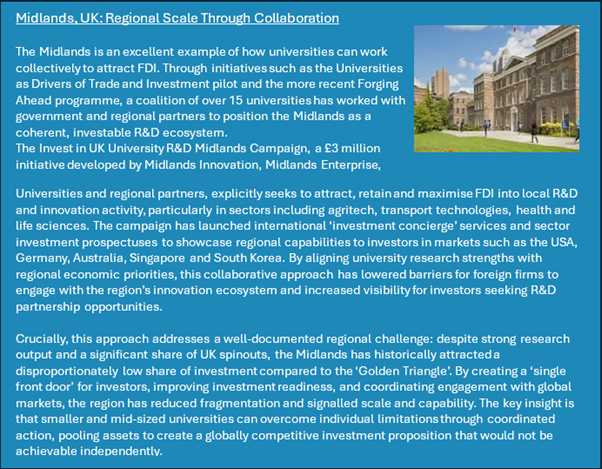
Regional Collaboration (Hunting in Packs)
Universities can attract FDI by collaborating regionally to present a unified, larger scale innovation ecosystem. By jointly promoting strengths, aligning skills and talent pipelines with industry needs and co-developing research hubs, incubators and commercialisation platforms, they can create a compelling offer for global investors. Working closely with government on infrastructure and incentives, simplifying industry engagement through a single access point and building international visibility further enhances attractiveness. A coordinated approach signals scale, reduces risk and demonstrates a region’s ability to turn research and talent into economic opportunity.
Case Studies
What The Evidence Tells Us
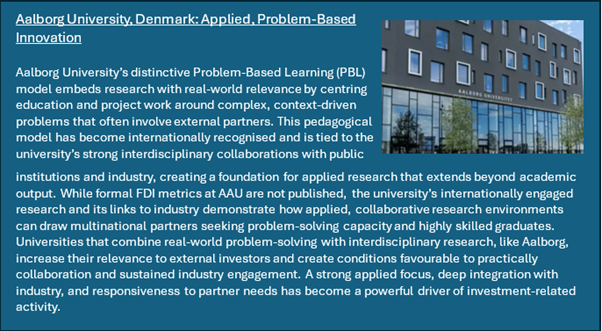
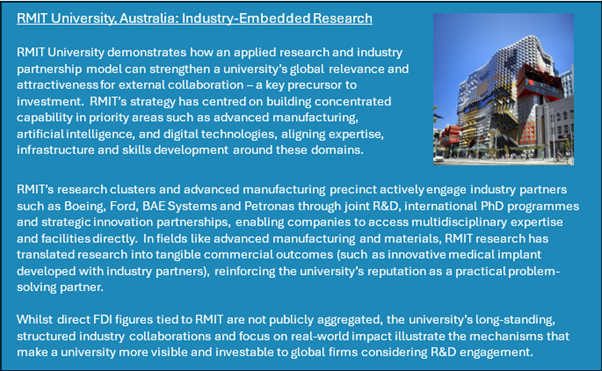
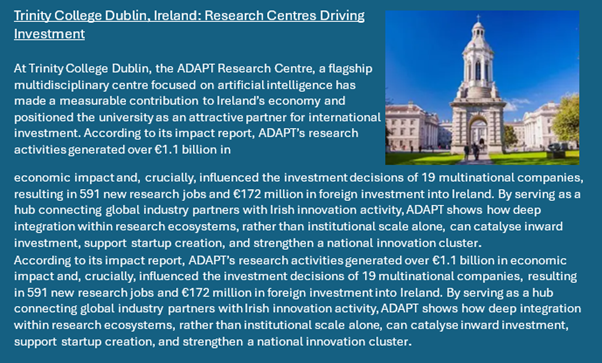
These brief case studies demonstrate how universities attract FDI not simply through scale or global reputation, but through the strength of their alignment with industry, their role within regional ecosystems, and their ability to signal capability to external investors. Three common factors emerge from the four examples:
- Institutions that demonstrate clear strengths in priority sectors are better positioned to attract investment than those with diffuse portfolios.
- Connectivity is critical, whether through deep industry partnerships, collaborative research centres, or regional coalitions. Universities that actively link firms, talent, and innovation infrastructure create more investable environments.
- Scale can be constructed, not just inherited. The Midlands case demonstrates how smaller and mid-sized institutions can overcome individual limitations by coordinating regionally and presenting a unified offer.
Importantly, these findings align with the wider evidence base on FDI in knowledge-intensive sectors, which show that investors prioritise access to skilled talent, research capability, and innovation ecosystems over institutional prestige alone. The implication for policymakers and university leaders is clear: attracting FDI is less about institutional hierarchy and more about strategic positioning, collaboration, and ecosystem development.
Implications For Policy And Strategy
The evidence base supports several policy directions to support Universities becoming FDI enablers:
- Improve measurement of FDI into university R&D – data gaps continue to be a consistent issue
- Align research strengths with investment strategies, particularly at regional level
- Strengthen collaboration mechanisms including co-funded research and industry partnerships
- Support commercialisation and innovation infrastructure
- Address regional imbalances in FDI distribution
- Enable broader institutional participation – current evidence suggests FDI is concentrated, indicating untapped potential across a wider range of universities
Actionable FDI Strategies For Smaller And Mid-Sized Universities
- Collaborate Regionally: Pool research strengths to attract foreign investors.
- Focus on Niche Strengths: Highlight sectors and research areas where you excel.
- Strengthen Industry Linkages: Offer co-funded projects, industrial PhDs, and shared labs.
- Enhance Visibility: Promote your research clusters globally.
- Align with Government Strategies: Ensure regional development and FDI policies complement institutional goals.
- Track and Report FDI: Measure impact to attract further investment.
By focusing, collaborating, and strategically engaging with global investors, even modest-sized institutions can drive significant regional impact.
Conclusion
Universities are important contributors to attracting knowledge-intensive FDI, particularly through research capability, talent, and collaboration with industry. UK evidence confirms that FDI provides a meaningful, though unevenly distributed, contribution to university R&D funding.
While large, research-intensive institutions dominate current investment flows, this reflects patterns of concentration rather than inherent limitations. Mid-sized and smaller universities are not inherently disadvantaged in attracting FDI. By leveraging research specialisation, regional partnerships, and collaborative strategies, it is possible to compete on a global stage. Evidence from the Midlands pilot, and other international examples, shows that even modest- sized institutions can contribute significantly to regional innovation, international collaboration, and investment attraction.
With strategic alignment between universities, policymakers, and investors, the untapped potential of smaller institutions can be realised, turning them into powerful catalysts for regional and national economic growth.
Unlocking the full potential of FDI requires more than strong research, it demands clear positioning, strategic partnerships, and an understanding of how global investors engage with innovation ecosystems. MSI works with universities, governments, and regional stakeholders to design and deliver FDI strategies that translate research and innovation strengths into investment outcomes. If your institution is looking to better attract, embed, or grow international investment, including through the development of micromultinational ecosystems, we would welcome a conversation on how we may be able to support your ambitions.

